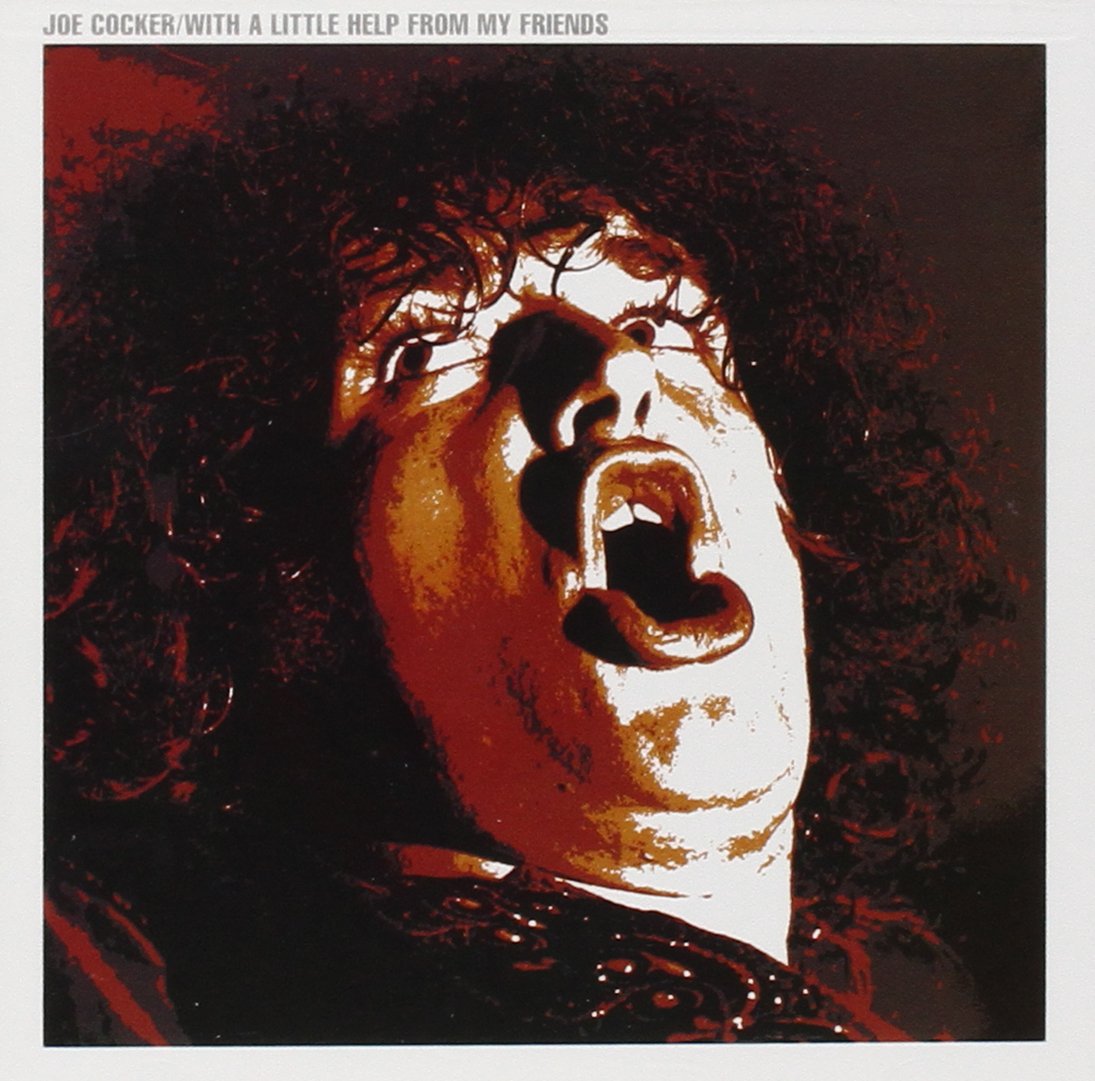
Joe Cocker !
Hot Wacks 6 (1975) © Bert


John Robert Cocker, born 20th May, 1944, was destined to become one of our finest singers and one of the most tragic figures the harsh world of rock has produced . To most people, Joe Cocker probably represents a handful of hit singles, a gravel voice and bizarre onstage mannerisms, but that’s just the tip of the iceberg . Joe’s beginnings in rock go back ten years to his home town of Sheffield . I’m sure everybody’s heard the one about Joe being the amiable gas-fitter who used to wander around with his bag of tools on his shoulder, whistling and singing to himself all the while . Joe’s first big influences were Ray Charles of course, Little Richard and Gene Vincent, although with the advent of the London R&B boom, Muddy Waters and Chuck Berry were soon added to the list .
Everybody plays up the Ray Charles influence when referring to Joe, who has this to say about Charles : « One day, over the radio, I heard ‘What’d I Say’ . It just knocked me out – the piano cryin’ out, his voice, everything . So I rushed out and finally found a copy of his ‘Yes Indeed’ album . Every track just amazed me and soon I became a complete Ray Charles fanatic . » Cocker had formed a group called the Cavaliers and they played a motley assortment of Chuck Berry, Buddy Holly and Muddy Waters tunes, although it must be stressed, more for fun than profit . The next Cocker band was a more promising venture, Vance Arnold & The Avengers, with Joe taking the part of Vance . They managed to get a few pub gigs which kept the wolf from the door and were invaluable experience ; also they got the chance of the odd gig at two of Sheffield’s « beat » clubs, the Esquire and the Club 60 (where Dave Berry, Sheffield’s other claim to rock fame, used to appear quite often . See Let It Rock 4 for a good account of those days .) The Avengers must have been quite a fair band, allowing even for the fact that record contracts were being scattered like confetti in an attempt to find another Beatles or Stones, because a talent scout (sounds a quaint phrase now, eh ? ) from Decca heard them and reported back to his superiors that a fabulous new singer was just waiting to be signed up . With the offer of a Decca contract in his hand, Joe pondered his future .
He didn’t feel ready to go full-time but his bosses at the Midlands Gas Board gave him a six-month leave of absence to see if it worked out . Joe was soon whisked down to London and put under the protective wing of Decca staff producer, Mike Leander (yes, he of Gary Glitter fame) who had Joe record a version of the Beatles « I’ll Cry Instead » and a version of the Wallace Brothers R & B hit, « Precious Words » (released in 1964 on Decca F.11974) . The original single, both showing the Ray Charles influence, is much sought after by collectors, although the appearance of « I’ll Cry Instead » on Decca’s recent « Hard Up Heroes » set has somewhat devalued it . A much better idea would have been, I think, to have gotten a hold of the only (?) other track Joe cut at that session, a version of Ray’s « Georgia On My Mind » complete with orchestra, choir and the lot . Joe regards it as Mike Leander’s personal ego-trip (obviously even then, Leander was looking for the big pay-off) which was originally scheduled to follow « I’ll Cry Instead », but due to Decca’s weird selection policy, it was shelved even though it had cost a mint in session fees and production costs . So if there’s ever a « Hard Up Heroes » vol . 2 on the go, I’d like to see « Georgia » on it . Well, to consolidate Joe’s recording debut, he was fitted onto the bills of a couple of package tours including being on a Stones & Hollies one and a Manfred Mann one . In all fairness, with the audience all baying and screaming for the head-liners, nobody paid any attention to the three-numbers-then-off opening acts . So Joe’s first brief brush with stardom had been rather anti-climactic and it was back to the drawing board (and the Gas Board) . The record had sold about 100 copies only, but at least it was a start, however small .
Undaunted by his failure to become a pop star, Joe formed a new band called Joe Cocker‘s Big Blues, which was in fact a Tamla Motown influenced soul band . Changing times had seen the end of rock ‘n’ roll and R & B as the moving forces in the clubs . Stax and Tamla were the « in » labels and it was very much an adapt-or-die scene in those days . If nothing else, even in those early days, Joe Cocker was paying his dues in full . The Big Blues landed a fairly lucrative contract playing to mainly black audiences at US Air Force bases in France . Back in England, they did manage to break out of Sheffield and got as far North as Manchester . It was around this time that the Cocker/Chris Stainton partnership was begun and it also saw the birth of a famous name, the first Grease Band . Stainton was also from Sheffield and like Cocker had come up the hard way via a series of local bands albeit more sophisticated, including one called Johnny Tempest & The Cadillacs which featured matching red suits, doing Cliff and Shadows numbers, right down to the choreography !
Although there was a change of name, there was no real change in musical policy and as soul music fell into its hackneyed, « have mercy, Y’all, sock it to me » bag, Joe became a bit brought down and disillusioned and the band folded . After almost a year spent pondering his future, he eventually decided to carry on much as before, following every new trend and jumping on every bandwagon . Remember, Sheffield had no booming R&B-type scene like London did with the Crawdaddy / Eel Pie Island / Klooks Kleek / the Marquee and dozens more and consequently there was no outlet for music other than pubs and discos . Things might have gone like this forever had it not been for a DJ in a Chesterfield club called Dave McPhee, an old friend of Cocker’s . Cocker and Stainton had recorded a home demo of a song called « Marjorine » and McPhee, in true story-book fashion, passed the tape onto impresario and studio boss, Tony Hall . Hall in turn, passed the tape onto fellow producer Denny Cordell and for the relatively simple task of passing on a tape, Hall earned himself 1% of Cocker for life . The original demo is of legend status now and Tony Visconti, who worked for Cordell at the time, had this to say to Sounds : « I was there when the demo came in, Joe Cocker discovered himself really because when we heard it we couldn’t believe our ears . In fact that demo was never duplicated – it should have been released as it stood . »
For the second time in his career, Joe was to travel down to London to record . This time he was accompanied by Chris Stainton but without the rest of the Grease Band who preferred the safety and security of full-time day jobs in Sheffield . I assume they were the Tom Rattigan and Frank Myles who are credited with Joe and Chris as the authors of « Marjorine » . Despite being impressed enough by the demo to travel up to Sheffield to check them out, it was a different story in London . Cordell was busy with the Move and Procol and Tony Visconti was producing Manfred Mann and nobody really had the time to handle the Grease Band . Chris Stainton did the arrangement and played bass and piano with Clem Cattini on drums and Jimmy Page and Albert Lee on guitars . Despite the line-up and a good radio and disco play, « Marjorine » was destined to become a forgotten classic . The B-side, « New Age Of The Lily » is alternately a Beatle rip-off and a flower power hype but the beginnings of that unique vocal style are there . On the strength of the single, Cocker began to get a few gigs around London, including the Marquee, and that was most people’s introduction to Joe’s stage act . Apart from the grittiest, soul-filled and emotive voice to come out of Britain in a long time, Cocker was also noted for his flailing, windmill-like mannerisms and his imaginary guitar playing, alternating between the absurd, graceless, and spastic-like twitching which Dave Marsh described in Creem as « … a raving bundle of flying hair and meat . Undeniably spastic, he twitches and strums his pseudo guitar fantasizing God knows what, turning unexpected songs into cathartic mini-psychodramas . » Later, all Joe could offer by way of explanation was : « I’ve always done me theatrical bit of throwing me arms about onstage… But you know, it’s not contrived – why would anyone contrive a stage routine that turns so many people off ? »
A second Grease Band had been formed and it included Kenny Slade on drums and Tommy Eyre (later of Aynsley Dunbar and Mark-Almond) . This was the band that was to record the follow-up to « Marjorine », a record that would break Cocker in every record market in the world . What we are talking about is, of course, Joe’s version of « With A Little Help From My Friends » . It is so radically different from the Beatles version that it had to succeed . A gentle, building organ intro leads to a stinging Jimmy Page guitar break then dies to let Joe come in then it builds to a fantastic crescendo of Joe’s voice, answering the vocal chorus and Jimmy’s guitar again . After an initial launching on the Simon Dee Show it quickly became a number 1 record here and worldwide . It also introduced the patented Joe Cocker scream which he admits : « I didn’t really know what I’d started when I did that . » The success of which took everybody by surprise and an album and a US tour were called for . But first, Joe had band problems ; Kenny Slade and Tommy Eyre were not working out at all . They were fine musicians, but too jazz-influenced to make it as rockers . So the split came and the definitive Grease Band was formed with Henry McCullough on guitar (from the Hendrix protégés, Eire Apparent) and Alan Spenner on bass and Bruce Rowlands on drums (both of whom had recently departed Wynder K . Frogg when Mick Weaver split to join Mason, Capaldi, Wood & Frogg – see Traffic article) .
With the success of the single, work had been going on on the album for almost a year before it was released . Denny’s attitude to Cocker, now with a number 1 record behind him, changed and he devoted a lot of time to make sure the album was a winner . There are 29 musicians involved in the album and it stems from Denny’s desire to make every track as good as possible, hence various combinations of musicians are used, many of the takes not being used, despite apparently great sessions by Al Kooper, Aynsley Dunbar etc . Amongst the names here are Jimmy Page, David Cohen, Albert Lee, Carole Kaye (the Motown lady bassist), Mike Kellie, BJ Wilson, Matthew Fisher and Steve Winwood in some terrific line-ups . Apart from the singles, « Marjorine » and « Friends », there are eight other songs, two really promising Cocker/Stainton songs – « Change In Louise » and « Sandpaper Cadillac » – and the rest of the album being good solid contemporary material of the day . Dave Mason’s « Feelin’ Alright », Dylan’s « Just Like A Woman » and « I Shall Be Released » (both incredible versions), Pete Dello’s (of Honeybus : strange band indeed – commercial success on one hand and yet also able to do a fine brace of « Top Gears ») « Do I Still Figure In Your Life » and a near-to-the-Animals version of « Don’t Let Me Be Misunderstood » . Lastly, and probably as a sop to the Ray Charles sound, a dazzling version of « Bye Bye Blackbird » (yes ! the same one), complete with fine Jimmy Page guitar . Throughout the album there is a whole lot of tasteful playing, none of your typical all-star flops that usually emanate from sessions like this . Jimmy Page in particular is really in great form and so is Steve Winwood, who wanted to do all the sessions on the second album, but due to Blind Faith’s tour, he had to cancel out . Matthew Fisher also chips in some lovely, ethereal, Procol-like organ layers, but let’s not underestimate Chris Stainton’s keyboard work – he is, I assume, the uncredited pianist on « Do I Still Figure In Your Life . » A fabulous debut album then, with Cocker in really great form and everyone playing their parts well and backing him to the hilt . All that was needed now was for it to sell, something it did not do at all well in Britain . Cocker reckons that the heads weren’t too keen on his gas-fitter background, it smelled of hype . More’s the pity for them and Cocker and they all missed out on a great experience . So with sales of around 6,000 or so over here, Cocker took off for America, where he couldn’t do a wrong move . The album was a smash and sold 200,000 copies straight off . Also, a torrid performance at the Woodstock festival inscribed him in the memories of all who saw him . Soon too, would begin the chain of events that would build Cocker-mania to unprecedented heights in America ; the arrival of Leon Russell .
During the tour, a copy of « The Original Delaney & Bonnie » album arrived at Cocker’s hotel and, like most others at the time, Cocker was absolutely knocked out by it, especially the piano player : Leon Russell, long time session man (Glen Campbell, the Byrds, Dorsey Burnette and even Sinatra) and opportunist (witness his manipulation of Gary Lewis, the Knickerbockers etc . ) who was keen to break into the rock sector (the whole Leon Russell/Delaney & Bonnie story is gradually being assembled for you, but as my regard for them wanes daily, I’m not sure what form it will take yet . Watch out though) . Also, Denny Cordell was at this time, early 1970, in the process of forming Shelter Records in partnership with Russell so that too, would have a profound effect on Joe’s future .
Very quickly thereafter, Cocker and Russell met up at Russell’s labour of love, his in-home studio, Skyhill, built by the sweat and labour of a thousand sessions . Cocker liked what he heard and a quick working partnership was soon struck up . The first fruits of which were Cocker’s recording of two Russell songs, one of which, « Delta Lady » was released in October 1969 (almost exactly a year after « With A Little Help From My Friends ») . « Delta Lady » is a typical Leon Russell-type tune, great piano riff, backing singers well in evidence and a great « Swamp rock » feel . Considering the long gap between the release of the two, « Delta Lady » did very well to reach the top ten here, which shows that Cocker was not the gimmicky, one-hit wonder he was still regarded as in England . A second US tour was quickly set up as it became obvious that this was definitely the place for Cocker to concentrate on . A second album was to be recorded as well, and in contrast to the first, was much more « American » in concept and feel . Gone were the cream of British session talent and in their place came their US counterparts including Russell on piano, Milt Holland on drums, Sneaky Pete and Clarence White on guitars and the quickly becoming essential backup vocals of Merry Clayton, Rita Coolidge, Bonnie Bramlett and Shirley Matthews . As far as selection of material goes, « Joe Cocker ! » is superb : this time around, only one Cocker/Stainton tune, the excellent « That’s Your Business » . Apparently the Beatles were so happy with Cocker’s reading of « With A Little Help… » that they sent round advance copies of « Abbey Road » and from them Cocker chose « She Came In Thru’ The Bathroom Window » and « Something » . Dylan’s « Dear Landlord », John Sebastian’s « Darling Be Home Soon », Leonard Cohen’s « Bird On A Wire » and, of course Russell’s « Delta Lady » and « Hello Little Friend » . Lloyd Price’s old rocker, « Lawdy Miss Claudy » completes the set . The obvious noticeable difference from the first album is the more good-timey feel throughout, gone is the emotion, the pain and the desperation . Apart from « Bird On A Wire », which is suitably doomy and possibly « Something » and « Hello Little Friend », everything else is very much an up-tempo groove, even Dylan’s « Dear Landlord » which ain’t meant to be a happy song . However, the sheer exuberance of « She Came In Thru’ The Bathroom Window », « Delta Lady », « Hitchcock Railway » and « Darling Be Home Soon ? » show that there’s more to Cocker than just another tortured soul singer . So two albums out of two and both stone classics, albeit of different moods and forms . Again, the Cocker persona was such that it was more than just session fees that drew people to him ; like Page and Winwood before him, Sneaky Pete wanted to join the band but the pull of the Burritos prevailed and Clarence White wanted so much to play live with the band because he felt he hadn’t done as much on « Dear Landlord » as he could have . On the first Cocker tour, the Grease Band often had to play second and third billing and a very good reaction to Cocker’s set is described by Ben Fong-Torres in Rolling Stone 60 (June 11th 1970 despite the gig taking place in June 1969 ! ) where they played a fantastic set below the « Doctor Jekyll »-era Byrds and Pacific Gas and Electric . The second tour again saw them in contact with the Byrds and the Burritos so obviously friendships developed ; the thought of Sneaky Pete and Clarence White in a Cocker band was really something .
Again, like its predecessor, « Joe Cocker ! » was a huge Stateside smash and a British failure . It sold even less than « Friends » in England, despite being a gold record in America ; in fact it seemed to spend the major part of 1970 high in the US charts .
The second tour was a mammoth three-month slog round the States and when it finished, Joe arrived at Denny Cordell’s LA residence looking forward to a good, long rest . This was not to be the case because twenty-four hours later Dee Anthony of Bandana Management (in his pre-Humble Pie management days) let it be known that he had arranged another two-month tour to begin the following week in Detroit . This came as a complete shock to Cocker, who had just disbanded the Grease Band and had sent them back to England and had no intentions of going through with another marathon tour so soon after finishing one . However, Anthony had Cocker’s signature some time previously on a contract to do the tour and that complicated things . Failure to do the tour would involve a lot of future hassles with promoters, the Musicians Union and even the immigration authorities who could bar any future entry into the States . With all this legalised blackmail against him Cocker had to say yes . With no band, and only a week to find one, he turned in desperation to Leon Russell who promptly set things in motion for the most traumatic stage of Cocker’s career . Russell went to work right away and very quickly recruited drummers Jim Keltner and Chuck Blackwell . Now Carl Radle had just quit Delaney & Bonnie and joined up with Cocker, in the process telling Russell that quite a few of D&B’s band were on the verge of quitting so another chance phone call fixed up Jim Price, Jim Gordon and Bobby Keys (familiar names now, but in 1970 they were just setting out on their supersession men road to fame, the Stones and the Dominoes would come later) . This little incident upset the Bramletts quite a lot and they accused Russell and Cocker of « pirating » their band although they calmed down later . Percussionists and backup singers were no problem and soon twenty or so souls were rehearsing like mad at A&M’s Hollywood film lot and things were at such an advanced state that the fourth day’s rehearsals resulted in Joe’s next single, the Box Tops old classic « The Letter » b/w « Space Captain » (by recently recruited Matthew Moore) . Again, the single had moderate British success compared to its American dimensions . To fly this motley bunch around the States, by now dubbed « Mad Dogs and Englishmen », an ancient Martin 202 twin-prop was hired but the addition of wives, lovers, children, secretaries and a five-man film crew necessitated the hire of a larger (although equally ancient) Lockheed « Super Constellation » four-prop . The fifty-two dates were recorded and filmed for posterity and resulted in a double album and film both entitled « Mad Dogs and Englishmen » . It is at this point, with the benefit of hindsight, that you realise that Joe was being taken for a big con by Russell et al . On record it sounds like back-slapping bonhomie, down-home good fun, with ol’ Joe, good ol’ Joe holding it all together . However the film is a different kettle of fish – Russell hustling like crazy to get Joe into a Shelter T-Shirt ; Russell with his garish clothes trying to steal the limelight for himself and Shelter, Joe on the plane, completely ignored by even the backing singers and who, for Christ’s sake, are they to ignore anybody ? A massive flying clique to whom Cocker was an outsider and merely the excuse for this never-ending party . In the hotel kitchen, a tour aide ordering food and wine though it was going out of fashion and all on Cocker’s tab . Didja know that for 52 gigs in 59 days Cocker made a personal profit of less than a thousand dollars . OK, so maybe it was on Joe’s tab but some of those cats just used him . Tell ya what… look at the credits to that album and tell me a singer or musician who hasn’t bettered himself since then… Russell, Don Preston, Carl Radle…